




![Popular Small-Size Actress Aunty Ajara Dies After Liver Illness [VIDEO]](https://thepunchng.com/wp-content/uploads/2026/02/20241109_125042-75x75.jpg)



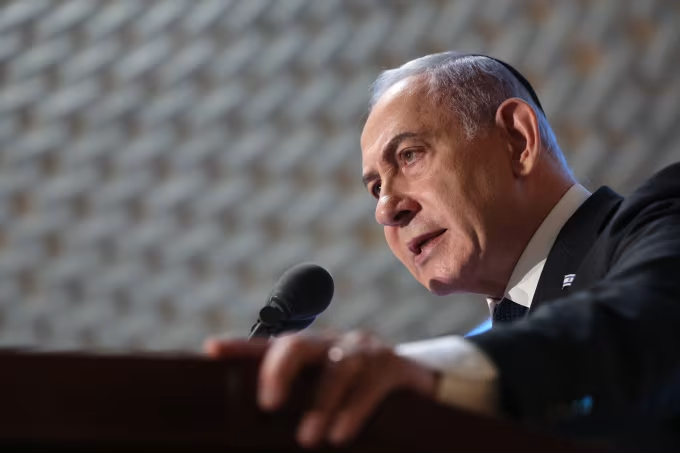
When Israeli Prime Minister Benjamin Netanyahu meets U.S. President Donald Trump at Mar-a-Lago this week, the moment will represent far more than a routine diplomatic reunion. For Netanyahu, it is widely seen as the opening move in a carefully choreographed campaign for Israel’s 2026 general election—one in which Trump is expected to play a central, even starring, role.
Israel is officially scheduled to hold elections in October 2026, but that timeline remains fragile. Two immediate threats hang over Netanyahu’s governing coalition: a brewing crisis over ultra-Orthodox military conscription and the March 2026 budget deadline. Either could collapse the government and force early elections.
A Survivor of Political and National Upheaval
Netanyahu’s sixth government—capping nearly 18 years across multiple premierships—has endured some of the most turbulent chapters in Israel’s history. His tenure has spanned the mass protests against the 2023 judicial overhaul, the October 7, 2023 Hamas attack that killed more than 1,200 Israelis, and the prolonged war that followed, leaving Israel diplomatically isolated and internally divided.
Yet Netanyahu has survived. His coalition has outlasted every Israeli government of the past six years, buying him time to reassert Israel’s regional deterrence while avoiding a full reckoning over the failures that preceded the October 7 attack.
Public opinion, however, remains stubbornly unfavorable. Polls conducted since late 2023 consistently show Netanyahu’s bloc falling short of the 61-seat Knesset majority needed to govern, hovering between 49 and 54 seats. His path to reelection appears to rest on a single strategic bet: distance himself from October 7—and rely on Trump to help reshape the political narrative.
“The U.S. president is going to be central—if not the lead—in Netanyahu’s reelection strategy,” said Nadav Shtrauchler, a political strategist who previously worked for the prime minister.
A Proven Political Alliance
The Netanyahu-Trump partnership has a long track record. During Israel’s turbulent 2019–2020 election cycles, Likud billboards across the country featured the two leaders shaking hands beneath the slogan: “Netanyahu, in a different league.” At key moments, Trump delivered headline-grabbing gestures—recognizing Israeli sovereignty over the Golan Heights in 2019, unveiling a Middle East peace plan in 2020, and brokering the Abraham Accords.
More recently, Trump has championed Netanyahu’s controversial pardon campaign. During an October address to the Knesset celebrating the Gaza ceasefire, Trump publicly urged Israeli President Isaac Herzog to grant Netanyahu clemency, dismissing the corruption charges against him as trivial matters of “cigars and champagne.”
The remarks ignited a Likud-aligned campaign that culminated in Netanyahu formally requesting a pardon. In a video accompanying his appeal, Netanyahu explicitly cited Trump’s support, arguing it would allow both leaders to advance “vital interests during a time of fleeting opportunity.”
Shtrauchler describes Trump’s Knesset speech as “de facto the launch of Netanyahu’s election campaign—managed by the best campaigner in the world.”
“Trump will probably reappear on Netanyahu’s campaign posters, as he has in the past,” Shtrauchler said. “His presence will hover over the campaign. It’s about quality, not quantity.”
A senior Likud source confirmed that Netanyahu has already discussed hosting Trump in Israel during the campaign, potentially marking Trump’s second visit since returning to the White House. Netanyahu’s office declined to comment.
Why Trump Matters to Israeli Voters
The political calculus is clear. A September 2025 Gallup poll showed U.S. leadership approval among Israelis at 76%, nearly double the 40% approval rating for Israel’s own government. Trump’s role in brokering the Gaza ceasefire further boosted his standing.
Netanyahu’s message, insiders say, will revolve around diplomatic spectacle: expanding the Abraham Accords, normalizing relations with Saudi Arabia, and reshaping the Middle East. These goals dovetail neatly with Trump’s ambition for a Nobel Peace Prize—an effort Jerusalem has actively encouraged. Knesset Speaker Amir Ohana recently partnered with U.S. House Speaker Mike Johnson to launch a global parliamentary initiative urging world leaders to back Trump’s nomination for the 2026 award.
“For Netanyahu, legacy is everything,” Shtrauchler said. “The message will be: I’ve achieved a lot, but the mission isn’t finished—there’s Iran, and there are more peace deals to be made.”
A Fragile Regional Reality
Despite the rhetoric, Trump’s vision of historic Middle East peace faces daunting obstacles. The Gaza ceasefire remains fragile, with pressure mounting to advance Phase Two. No international force has emerged to govern Gaza, Hamas shows little sign of disarming, and Arab states once expected to rush into normalization remain hesitant.
Tensions persist elsewhere. On Syria, Trump’s engagement with the Al-Sharaa leadership contrasts with Israel’s insistence on maintaining a buffer zone. In Lebanon, Washington favors diplomacy, while Jerusalem doubts Beirut’s ability to rein in Hezbollah without another military campaign.
Iran remains the most dangerous flashpoint. While both leaders hailed the brief “12-day war” as a success, Tehran’s nuclear enrichment and ballistic missile programs continue largely unabated. Israeli officials privately question whether Trump would authorize another major strike on Iran, especially after the backlash following Israel’s controversial September operation against Hamas leadership in Doha.
White House Deputy Press Secretary Anna Kelly underscored Washington’s stance, saying:
“Israel has had no better friend in its history than President Trump. We remain committed to ensuring Iran never obtains a nuclear weapon.”
Gaza, Politics, and Strategic Trade-Offs
Gaza remains the most politically sensitive arena. Trump is pressing for progress, while Netanyahu faces resistance from right-wing coalition partners opposed to further withdrawals. Israeli sources suggest Netanyahu may authorize one final military operation in Gaza—enough to placate his allies—before advancing the ceasefire.
“Netanyahu never operates in a vacuum,” said a former Israeli official. “Trump’s inner circle, Gulf allies, and partners in Turkey and Qatar are increasingly frustrated with the delays and wary of any move that could destabilize the region.”
Officials say Netanyahu’s strategy revolves around linkage politics—progress in Gaza tied to security guarantees against Iran and Lebanon, alignment with domestic political timelines, and possibly U.S. backing on his pardon effort.
“He trades movement on one front for compensation on another,” a senior Israeli official said. “The real question is what he gets in return—support for a strike on Iran, or backing for military action in Lebanon.”
The Power—and Limits—of Trump’s Shadow
Even without historic breakthroughs, Trump offers Netanyahu something invaluable: attention. Every visit, statement, or social media post dominates headlines, crowds out opposition messaging, and redirects public debate away from October 7.
“Their alliance is strong and grounded in shared views,” Shtrauchler said. “There may be clashes, but they work them out. Netanyahu delayed many decisions until Trump’s return—and expects the favor to be repaid.”
History, however, offers a cautionary note. Trump’s interventions helped Netanyahu survive previous elections, but they never delivered a decisive victory. Between 2019 and 2021, Israel endured five elections in four years, with Netanyahu repeatedly failing to secure a stable governing majority.
Trump may be the most powerful card in Netanyahu’s political hand—but as recent history suggests, it may still fall short of a winning one.
Punch contributed to this repor