




![Popular Small-Size Actress Aunty Ajara Dies After Liver Illness [VIDEO]](https://thepunchng.com/wp-content/uploads/2026/02/20241109_125042-75x75.jpg)



When a sitting or former U.S. president publicly declares that military options are being prepared against a sovereign nation, the statement demands serious scrutiny—not panic, but clarity.
Donald Trump’s recent remarks alleging a “genocide” against Christians in Nigeria, alongside his directive for the U.S. government to “prepare fast” for potential military action, appear less like an imminent strategy and more like a calculated political signal. Beneath the rhetoric lies a familiar mix of diplomatic pressure, domestic political messaging, and the instrumentalization of religion in global power politics.
For Nigeria, the moment is a stress test—not only of its relationship with Washington, but of its own institutional resilience and sovereignty.
Rhetoric as Leverage: Political Theater Disguised as Policy
Policy analysts widely interpret Trump’s comments as political theater rather than actionable military planning. Historically, U.S. leaders have used public threats to extract concessions, energize domestic constituencies, or reframe international narratives—often without intent to follow through.
In Trump’s case, the language of defending “Christians abroad” speaks directly to his evangelical base and influential Christian advocacy networks. Nigeria, a country marked by religious diversity, internal security challenges, and strategic importance in Africa, becomes a convenient stage for this performance. Casting himself as a global protector of persecuted Christians allows Trump to revive a familiar political persona.
Yet the practical realities tell a different story. Nigeria remains one of Africa’s most consequential states, with over 200 million people, deep involvement in regional peacekeeping, and longstanding security and economic ties with the United States.
Any direct U.S. military intervention would require overwhelming logistical preparation, legal justification, coalition support, and—most importantly—Nigeria’s consent. An outright invasion is highly implausible. The real pressure lies not in troops, but in diplomacy and narrative framing.
Sovereignty Under Strain: Nigeria’s Official Position
Nigeria has firmly rejected the characterization of its security crisis as a Christian genocide. Government officials insist that the violence stems from overlapping challenges—insurgency, banditry, farmer-herder clashes, weak governance, and organized crime—none of which can be reduced to religion alone.
In an exclusive interaction with Eagle Intelligence Report (EIR), a senior official from Nigeria’s Ministry of Foreign Affairs outlined Abuja’s approach. While acknowledging Trump’s rhetoric, the official emphasized Nigeria’s commitment to its longstanding partnership with Washington across security, health, trade, and civic cooperation.
“Security cooperation will continue,” the official said, “where it respects Nigeria’s sovereignty, legal frameworks, and operational priorities.”
According to the official, Trump’s remarks reflect a blend of genuine human rights concerns and broader geopolitical signaling, shaped in part by U.S. domestic politics. Rather than escalate tensions publicly, Nigeria is opting for quiet, fact-based diplomacy—aimed at correcting the narrative without inflaming divisions or empowering extremist groups.
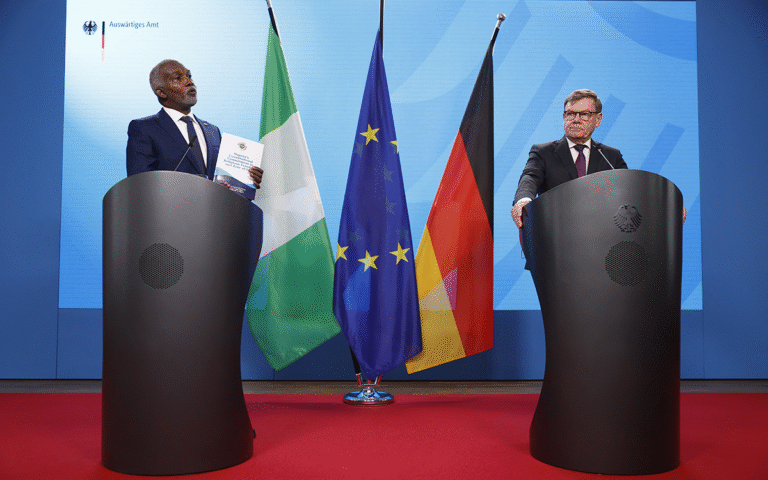
This position was echoed publicly by Foreign Minister Yusuf Tuggar, who, speaking at a press briefing in Berlin on Tuesday, November 4, reaffirmed Nigeria’s constitutional stance on religious freedom.
“It is impossible for there to be religious persecution supported in any way, shape, or form by the government of Nigeria at any level,” Tuggar said.
Faith, Conflict, and the Weaponization of Identity
Religion in Nigeria is deeply woven into identity, politics, and history. The country is roughly divided between Christians and Muslims, but violence—particularly in the North and Middle Belt—rarely follows a simple religious binary.
Jihadist insurgency, organized banditry, land and resource competition, state fragility, and porous borders all play critical roles. Both Christians and Muslims are victims of the same systemic failures.
By framing Nigeria’s crisis as Christian persecution, Trump simplifies a complex reality in ways that resonate with U.S. audiences but risk deepening internal tensions in Nigeria. Such narratives elevate one group’s suffering while obscuring the broader governance and security collapse affecting all communities.
Prominent Nigerian voices across ideological and religious lines have warned against this framing. Activist Omoyele Sowore cautioned that foreign military rhetoric rarely delivers stability.
“No one—Christian, Muslim, or otherwise—should celebrate this,” Sowore said. “The United States has a long record of interventions that leave countries worse off. Nigeria doesn’t need a foreign savior; it needs accountable leadership at home.”
Islamic scholar Ahmad Gumi, from a different perspective, accused Washington of exploiting Nigeria’s internal divisions, citing the country’s strategic value and natural resources. He warned that historical patterns—such as alleged foreign involvement during the Biafran War—risk resurfacing under humanitarian pretexts.
Despite their differences, these voices converge on one point: Nigeria must not become a pawn in foreign political drama dressed up as moral rescue.
Sources confirmed to EIR that President Bola Tinubu has instructed federal and state officials to refrain from public commentary while diplomatic channels with Washington work toward de-escalation.
Diplomacy in Motion: A Calculated Response
Behind the scenes, Nigeria is not standing still. The EIR inquiry points to a calibrated diplomatic strategy designed to defend sovereignty while preserving essential cooperation. Key elements include:
- Message Discipline: Coordinating official language across ministries to avoid missteps that could escalate tensions.
- Diversifying Partnerships: Reducing over-reliance on any single global partner by strengthening regional, multilateral, and emerging alliances.
- Back-Channel Engagement: Quietly briefing U.S. officials, former diplomats, and policy influencers with verified data to counter distorted narratives.
- Red-Lining Sovereignty: Making clear that unilateral military action is unacceptable—a stance Nigeria can enforce given its strategic leverage.
This is not a reactive posture, but a deliberate one.
What This Moment Means
For Nigeria
This episode tests Nigeria’s institutional maturity. Delivering credible security reforms, prosecuting perpetrators regardless of faith, and maintaining transparency with victims will undercut the moral leverage outsiders seek to exploit.
Religious freedom must be framed as the protection of all citizens—not as a competition for victimhood.
For the United States
If Washington seeks a durable partnership, it must move beyond spectacle. Cooperation rooted in capacity-building, governance reform, and sustained dialogue will achieve more than rhetorical posturing tied to domestic politics.
For Global Norms
The episode highlights the danger of weaponizing humanitarian and religious language in geopolitics. If “protection of Christians” can justify threats against Nigeria, similar logic can be applied anywhere—by any power. For Africa, defending sovereignty through reform and unity is not optional; it is essential.
The Bottom Line
Donald Trump’s threat to “invade” Nigeria is not an operational plan—it is a strategic signal, blending moral theater with power politics. The real story lies in Nigeria’s response.
As EIR sources confirm, Abuja has chosen quiet diplomacy, message discipline, and strategic diversification over confrontation. One senior official summed it up succinctly:
“Security cooperation will continue where it respects Nigeria’s sovereignty, legal frameworks, and operational priorities.”
That sentence captures the core of this moment.
For the United States: partner, don’t posture.
For Nigeria: deliver results, protect all citizens, and reclaim the narrative—on its own terms.