




![Popular Small-Size Actress Aunty Ajara Dies After Liver Illness [VIDEO]](https://thepunchng.com/wp-content/uploads/2026/02/20241109_125042-75x75.jpg)



By Stephen Wertheim
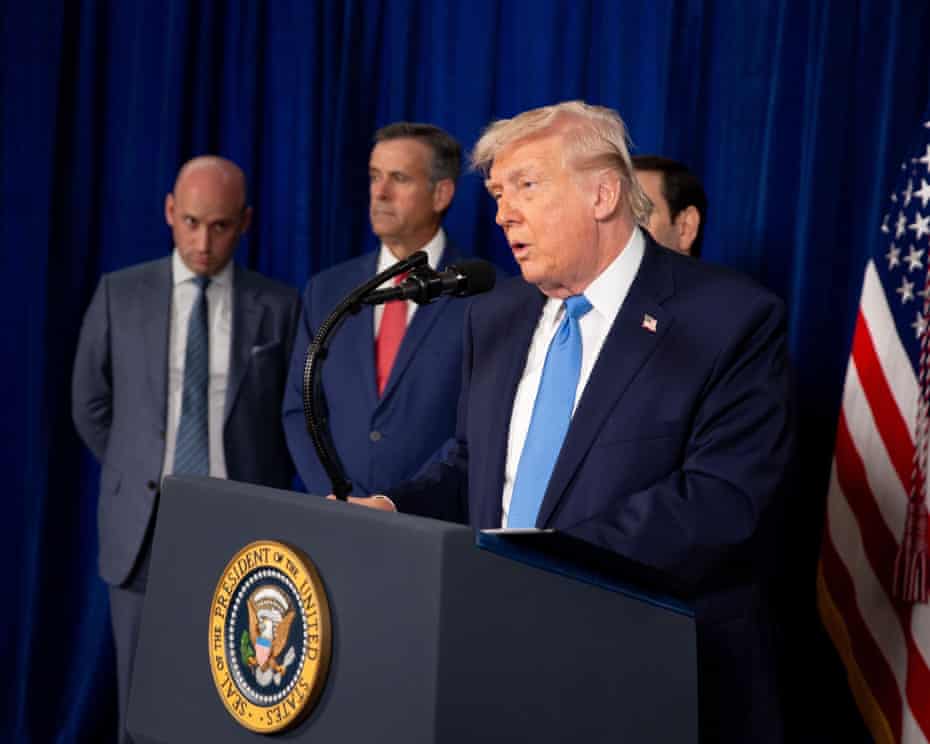
Donald Trump took office vowing to annex Greenland and reclaim the Panama Canal. Now, after ordering military strikes that led to the capture of Venezuelan strongman Nicolás Maduro, the list of potential targets appears to be growing.
“This is genius,” Trump remarked on 22 February 2022, after Vladimir Putin recognised parts of eastern Ukraine as independent and sent in Russian troops under the guise of peacekeeping. Trump even suggested the tactic could be replicated on the US southern border.
At the time, Trump did not realise he was witnessing the opening act of a devastating war that has lasted nearly four years and produced more than 1.5 million casualties. Nor does he appear to grasp what his actions in Venezuela may unleash. Venezuela is not Ukraine — nor is it Afghanistan, Iraq or Libya — but the lesson from decades of US foreign policy failures remains painfully clear: regime-change wars are easy to start and notoriously hard to finish.
A Familiar Pattern
So far, Trump has taken only the first step. Maduro’s regime has not been dismantled; it has merely been decapitated. Yet in announcing the strikes, Trump struck a triumphant tone, boasting of “overwhelming military power” — language reminiscent of past US interventions that began with operational success and ended in strategic disaster.
To hear Trump tell it, the hard part is already over. Peace, prosperity and freedom, he insists, will soon follow. “We are going to run the country,” Trump declared, signalling a willingness to deploy ground troops and exploit Venezuela’s oil reserves.
His initial post-Maduro plan was to leave Vice-President Delcy Rodríguez in charge, assuming she would cooperate with Washington. Within hours, Rodríguez rejected the claim, insisted Maduro remained Venezuela’s legitimate leader, and denounced the United States as an imperial invader bent on plunder.
Plan A collapsed almost immediately. What comes next remains unclear.
A Broader Regional Ambition
The implications extend far beyond Venezuela. Trump framed the attack as a reassertion of US dominance across Latin America. “American dominance in the western hemisphere will never be questioned again,” he proclaimed.
Last month, the administration unveiled a new national security strategy that introduced a so-called Trump Corollary to the Monroe Doctrine, claiming the right to use “any means necessary” to eliminate external influence in the Americas. While framed as a defensive doctrine, its scope is sweeping and vague.
Trump has increasingly cast threats closer to home — migrants, gangs and drug cartels — as existential enemies “invading” the United States. His pause during the Venezuela address to praise troops patrolling American cities underscored how blurred the line has become between foreign and domestic security.
From War on Terror to War on “Narco-Terror”
The strike on Caracas confirms a broader shift in US military posture. As the war on terror fades, it is being replaced by a war on so-called narco-terror. The enemy is no longer confined to the Middle East but reimagined as a fluid network of cross-border threats in the western hemisphere.
Trump’s definition of these threats is strikingly elastic, extending even to what he repeatedly labels “the enemy from within.”
Who’s Next?
Today, the target was Caracas. Tomorrow, it could be somewhere else.
Trump has already hinted at possibilities. He entered office pledging to annex Greenland and retake the Panama Canal. He has claimed that “the cartels are running Mexico” — an assertion that, in his framework, could serve as justification for military action. Secretary of State Marco Rubio has also issued warnings to Cuba’s government.
Even in a best-case scenario — where Venezuela swiftly transforms into a stable, oil-producing, pro-American democracy — success could embolden the administration to test the limits of its power elsewhere in the region.
But best-case scenarios are rare. More likely, Trump’s run of hit-and-run military actions will encounter the same resistance, instability and unintended consequences that plagued past interventions.
“Great nations do not fight endless wars,” Trump once said during his first term. The question now is unavoidable: what kind of nation is Trump’s America becoming?
Stephen Wertheim is a senior fellow in the American Statecraft Program at the Carnegie Endowment for International Peace and a visiting lecturer at Yale Law School.