




![Popular Small-Size Actress Aunty Ajara Dies After Liver Illness [VIDEO]](https://thepunchng.com/wp-content/uploads/2026/02/20241109_125042-75x75.jpg)


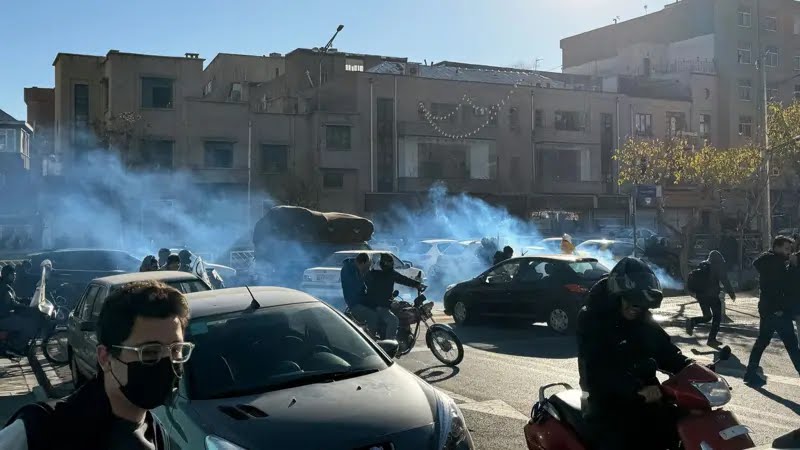
Iran is no stranger to street protests, but a convergence of domestic unrest and escalating international pressure has made the current wave of demonstrations particularly serious—and potentially destabilising.
Monday marks the ninth consecutive day of protests across the country. Yet even within the first few days, the crisis drew an unusually direct response from the United States. President Donald Trump issued a public warning to Iran’s leadership over the treatment of protesters, declaring that the US was “locked and loaded.” A second warning followed on Sunday, coming shortly after a US special forces operation targeting Venezuelan leader Nicolás Maduro.
Such explicit threats from a sitting US president, made while protests are still unfolding, are highly unusual. Analysts warn that this rhetoric could embolden demonstrators inside Iran and encourage the unrest to spread further.
Violent Response and Rising Casualties
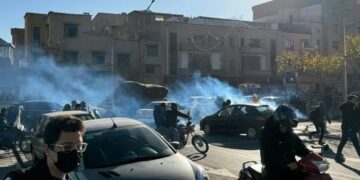
Iranian police and security forces responded forcefully almost from the outset. Human rights groups report that more than 20 people have already been killed, with hundreds more arrested. As the demonstrations persist, attention is increasingly focused on Washington—and whether Trump’s warnings will translate into concrete action.
Economic Anger Fuels the Streets
The protests began peacefully on Sunday, 28 December, driven largely by public frustration over Iran’s worsening economic conditions. Soaring inflation and the sharp devaluation of the rial against the US dollar—now roughly 80% weaker than a year ago—have pushed millions closer to hardship.
Iran’s economy is in deep trouble, with little prospect of meaningful growth this year or next. Official inflation stands at about 42%, food inflation exceeds 70%, and prices of some basic goods have reportedly risen by more than 110%.
A Vulnerable State
While international sanctions led by the United States have significantly worsened economic conditions, many Iranians believe sanctions alone do not explain the crisis.
High-profile corruption cases involving senior officials and their families have intensified public anger and reinforced the perception that parts of the ruling elite are profiting from the hardship. Many ordinary Iranians accuse certain officials—often referred to locally as “sanctions profiteers”—of exploiting loopholes that allow them to dominate imports and exports, move oil revenues abroad, and benefit from money-laundering networks.
Even within government circles, there is growing acknowledgment that these profiteers may be as damaging as the sanctions themselves.
From Bazaars to the Streets
Merchants in Tehran’s historic Grand Bazaar were among the first to protest openly, closing their shops in response to daily currency swings and demanding urgent government action to stabilise the markets.
The demonstrations quickly spread beyond the bazaar. Economic grievances soon gave way to political demands, with chants calling for the removal of the Islamic Republic itself. Students joined in, followed by small business owners in other cities and towns. Within days, slogans targeting Iran’s supreme leader once again became a defining feature of the protests.
Echoes of Past Unrest
The last nationwide unrest of similar magnitude occurred about four years ago, following the death of Mahsa Amini while in the custody of Iran’s morality police. That uprising—later known as the Mahsa Movement or “Woman, Life, Freedom”—became the most widespread anti-government protest since the Islamic Republic’s founding in 1979.
Although those demonstrations shook the state to its core, they were eventually suppressed through force, mass arrests, and intimidation.
While the current protests have not yet reached the scale or intensity of the 2022 movement, their rapid spread and persistence have alarmed both Iranian authorities and international observers.
Information Blackout and Verification Challenges
Journalists inside Iran are operating under extreme pressure. Independent international media organisations are either barred entirely or subjected to severe restrictions. As a result, much of the available information comes from social media and firsthand accounts shared by protesters.
This makes verification difficult, as social platforms can also amplify false claims, manipulated footage, and distorted narratives—a challenge further compounded by the growing use of artificial intelligence.
A Government Under Pressure
Despite these limitations, many analysts believe the current unrest could have more serious consequences than previous protests. Iran’s leadership is widely seen as being at its weakest point in decades, squeezed by internal dissent and a dramatically altered regional landscape.
A Series of Strategic Setbacks
The 12-day war between Iran and Israel in the summer of 2025 marked a major turning point. The conflict escalated into direct US involvement, including air strikes on Iranian nuclear and military facilities. Iran’s defence capabilities, nuclear infrastructure, and key industrial sites suffered significant damage.
Beyond its borders, Tehran’s regional influence has also declined. The fall of Bashar al-Assad in Syria deprived Iran of a crucial ally, while sustained Israeli attacks on Hezbollah in Lebanon decimated much of the group’s senior leadership.
More recently, US operations in Venezuela—including the capture of Nicolás Maduro and his wife, Cilia Flores—have reinforced perceptions in Tehran that Washington is increasingly willing to act decisively against its adversaries.
An Uncertain Path Ahead
Taken together, economic collapse, public outrage, regional losses, and unprecedented US pressure have placed Iran in a uniquely vulnerable position. Whether the government can contain the unrest—or whether the protests will escalate into a deeper national crisis—remains an open and highly consequential question.