




![Popular Small-Size Actress Aunty Ajara Dies After Liver Illness [VIDEO]](https://thepunchng.com/wp-content/uploads/2026/02/20241109_125042-75x75.jpg)



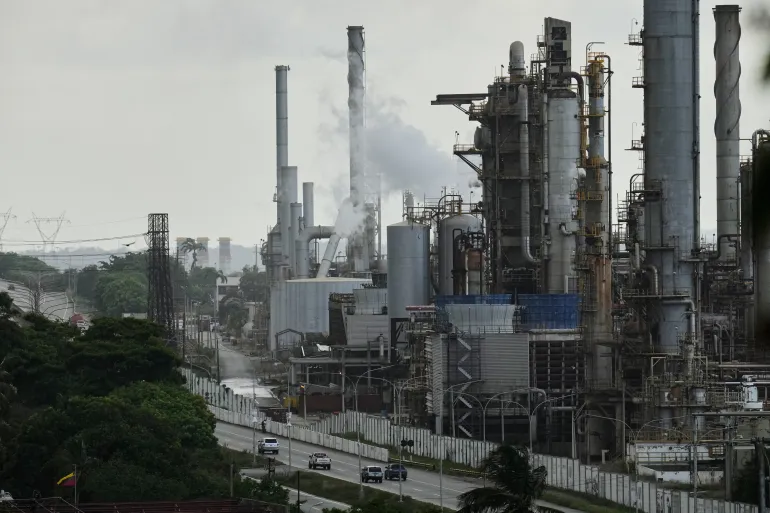
United States President Donald Trump has vowed to “take back” Venezuela’s vast oil reserves and push them into the global energy market, a move analysts say would face significant political, economic, and technical obstacles.
Despite Venezuela holding the world’s largest proven oil reserves, experts argue that years of decay in infrastructure, legal complications, leadership uncertainty in Caracas, and an already oversupplied global oil market make any rapid revival unlikely.
Vast Reserves, Limited Output
Venezuela is estimated to possess around 303 billion barrels of proven oil reserves, the largest in the world. However, its current production tells a very different story.
In November, Venezuela produced approximately 860,000 barrels per day (bpd)—less than 1 percent of global output. This is a sharp contrast to its peak production of 3.7 million bpd in 1970, highlighting the scale of the sector’s collapse.
Analysts attribute the decline to a combination of US sanctions, prolonged underinvestment, mismanagement, and corruption under President Nicolás Maduro and his predecessor, Hugo Chávez.
Sanctions Relief Not a Quick Fix
Energy experts say that while lifting US sanctions could offer a short-term boost, restoring production anywhere near historic highs would require massive capital investment and several years of sustained reforms.
Oil prices showed only modest movement in global markets on Monday, reflecting expectations that Venezuela’s output is unlikely to change significantly in the near term.
Crumbling Infrastructure and Talent Drain
“Venezuela’s oil infrastructure is in poor shape overall due to years of neglect,” said Scott Montgomery, a global energy expert at the University of Washington.
“Both equipment and oilfield wells have suffered from a lack of maintenance. The state oil company, PDVSA, is widely known for corruption and a shortage of technical expertise, as many skilled professionals have left the country,” Montgomery told The PUNCH.
Years Away From Peak Production
Thomas O’Donnell, an energy and geopolitical analyst based in Berlin, estimated that even under the most favorable conditions—such as a peaceful political transition and strong investment—Venezuela would need five to seven years to return to peak production levels.
“In the long term, if the political and security issues are resolved, Venezuela could again become one of the world’s major oil producers,” O’Donnell said. “But how quickly that happens depends entirely on the transition process and how well investments and security are managed.”