




![Popular Small-Size Actress Aunty Ajara Dies After Liver Illness [VIDEO]](https://thepunchng.com/wp-content/uploads/2026/02/20241109_125042-75x75.jpg)



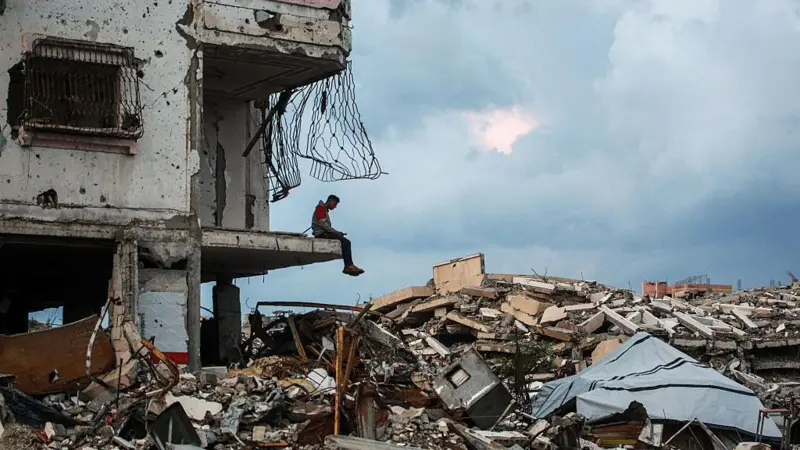
A ceasefire agreement brokered by the United States and led by former President Donald Trump was expected to bring an end to the devastating war in Gaza. Israel and Hamas both agreed in principle to the deal, but nearly two months later, it has yet to be implemented.
Despite intense diplomatic efforts, deep disagreements remain over key issues, leaving the agreement in limbo.
Hostages Remain a Major Obstacle
One of the most sensitive issues is the fate of Israeli hostages still unaccounted for, particularly police officer Ran Gvili, who was captured during Hamas’s 7 October attack on Israel.
Hamas says it has been unable to locate him amid the rubble of Gaza. Israeli Prime Minister Benjamin Netanyahu, however, insists that Hamas must release all hostages—dead or alive—before the ceasefire can move forward.
Gvili’s parents say Hamas knows what happened to their son and accuse the group of using his case as bargaining leverage. Hamas denies the allegation, arguing that Israel is deliberately slowing down the ceasefire process.
Disarmament of Hamas
Another major sticking point is Israel’s demand that Hamas surrender its weapons.
The proposed agreement includes the creation of an International Stabilisation Force (ISF) to oversee security and disarmament. Turkey has reportedly shown interest in joining such a force, but Netanyahu has strongly opposed the idea, a position said to be supported by Washington.
So far, no country has publicly committed to participating in the ISF.
According to veteran mediator Gershon Baskin, Hamas might agree to temporarily shelve its weapons or hand them over to the Palestinian Authority, but it is highly unlikely to disarm in favour of Israel or the US.
Israeli Military Withdrawal
Israel currently controls about 53% of the Gaza Strip.
Under the first phase of the agreement, Israeli forces were meant to withdraw to border areas along a line known as the “Yellow Line.” However, the second phase would require fresh negotiations on troop positions, reconstruction, and international monitoring—talks that have yet to make progress.
Retired Israeli general Israel Ziv says Hamas fears losing its grip on power, while Israel wants to maintain a military presence in Gaza for domestic political reasons.
Who Will Govern Gaza?
The future administration of Gaza remains unresolved.
The draft deal proposes an interim technocratic government with no role for either Hamas or the Palestinian Authority. Israel, however, argues that excluding both sides is unrealistic and fears Hamas could retain influence behind the scenes—or that Gaza could eventually return to Palestinian Authority control.
Pressure from Washington
US media reports say Washington is pushing for the second phase of the ceasefire to begin. Baskin believes Trump has already made up his mind and will pressure Netanyahu to act quickly.
“Israel has very limited options,” Baskin told thepunc. “Trump does not believe there is time to waste.”
Netanyahu–Trump Meeting Ahead
Netanyahu and Trump are expected to meet later this month in Florida, where the unresolved issues are likely to dominate discussions.
Netanyahu is expected to demand firm guarantees on Hamas’s disarmament, the exclusion of Hamas from any future Gaza government, the continued presence of Israeli troops in strategic areas, and the prevention of Turkish troop deployment.
Trump, meanwhile, is expected to press Netanyahu to stop delaying the ceasefire’s implementation.
Human Cost Continues to Rise
According to Gaza’s Hamas-run health ministry, nearly 400 Palestinians have been killed and about 1,000 injured since the ceasefire framework was outlined between 10 November and 15 December.
As negotiations drag on, the humanitarian toll continues to mount, underscoring the urgency of breaking the deadlock and bringing the ceasefire into force.