




![Popular Small-Size Actress Aunty Ajara Dies After Liver Illness [VIDEO]](https://thepunchng.com/wp-content/uploads/2026/02/20241109_125042-75x75.jpg)



Several civil society organisations (CSOs) have faulted the Nigerian Senate over its rejection of key provisions in the ongoing amendment of the Electoral Act, warning that the move could undermine electoral transparency and public confidence.
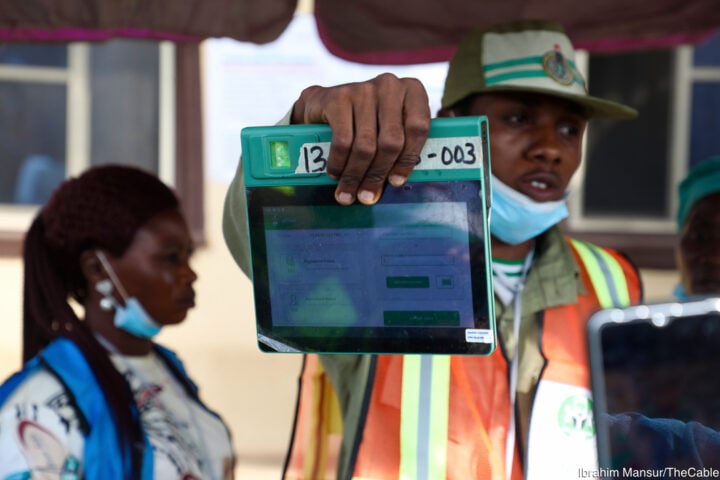
In a joint statement issued on Thursday, the organisations expressed strong concern over the Senate’s refusal to approve mandatory real-time electronic transmission of election results, a reform widely regarded as essential to reducing post-election disputes and strengthening the credibility of elections in Nigeria.
Rejected Reforms Raise Red Flags
According to the CSOs, the Senate also blocked a proposal that would have allowed voters to download missing or unissued Permanent Voter Cards (PVCs) online, a measure aimed at improving voter access and inclusion.
In addition, the red chamber approved significant reductions in critical pre-election timelines, including:
- Cutting the notice period for elections from 360 days to 180 days
- Reducing the deadline for political parties to submit candidates’ lists from 180 days to 90 days
- Shortening INEC’s window to publish nominations from 150 days to 60 days
The groups warned that these compressed timelines could limit public scrutiny, strain the operational capacity of the Independent National Electoral Commission (INEC), and create opportunities for electoral manipulation.
“A Setback for Electoral Integrity”
“The Senate vote represents a setback for electoral integrity,” the statement read.
“The undersigned civil society organisations express deep concern over the Nigerian Senate’s rejection of some of the most consequential legal reforms required to strengthen electoral transparency, inclusion, and credibility.”
The CSOs further criticised the Senate’s rejection of a proposed 10-year ban for electoral offenders, arguing that the absence of tougher sanctions weakens efforts to curb vote-buying and electoral corruption.
“Stronger sanctions, including electoral disqualification, are necessary to protect the integrity of the ballot and restore public confidence in democratic institutions,” the statement added.
Retreat From Electoral Act 2022 Gains
The organisations described the Senate’s overall position as a retreat from the transparency and voter-protection gains achieved under the Electoral Act 2022, noting that it contrasts sharply with the more progressive stance earlier adopted by the House of Representatives.
“Taken together, these decisions undermine the principles of transparency, certainty, and voter rights that underpinned the passage of the Electoral Act 2022,” the CSOs said.
Call for Reversal During Harmonisation
The groups urged lawmakers involved in the harmonisation process to prioritise national interest over partisan considerations by reversing the Senate’s position.
“At a time when public trust in elections remains fragile, Nigeria cannot afford legal provisions that weaken oversight or privilege political convenience over democratic integrity,” the statement noted.
Specifically, the CSOs called on the Conference Committee to:
- Adopt the House of Representatives’ position on compulsory real-time electronic transmission of results, including comparison with physical copies
- Retain existing statutory timelines for election notices, party primaries, and publication of candidates’ lists
- Conclude the harmonisation process swiftly and transmit the final bill to the President within one week
Signatories
The statement was jointly signed by the Centre for Media and Society (CEMESO), Kukah Center, International Press Centre (IPC), Elect Her, Nigerian Women Trust Fund, TAF Africa, and Yiaga Africa.