




![Popular Small-Size Actress Aunty Ajara Dies After Liver Illness [VIDEO]](https://thepunchng.com/wp-content/uploads/2026/02/20241109_125042-75x75.jpg)



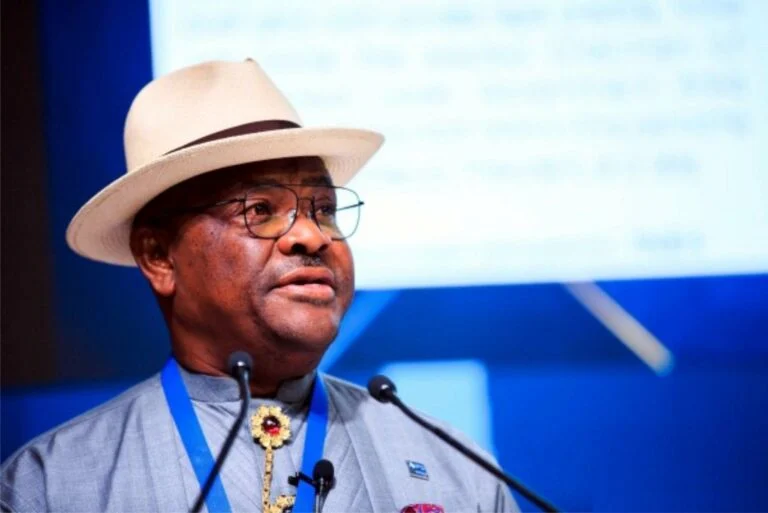
The Socio-Economic Rights and Accountability Project (SERAP) has filed a lawsuit against state governors and the Minister of the Federal Capital Territory (FCT), Nyesom Wike, over their alleged failure to account for billions of naira allocated as security votes since May 29, 2023.
SERAP said the suit was triggered by worsening insecurity across several states and the FCT, despite the enormous public funds budgeted annually for security votes. The organisation cited incidents such as mass killings in Benue State and other violent attacks nationwide as evidence of the continued security crisis.
Details of the Suit
The case, marked FHC/ABJ/CS/95/2026, was filed last Friday at the Federal High Court in Abuja. SERAP is asking the court to compel the governors and the FCT minister to publicly disclose details of how security votes received since May 29, 2023, have been spent.
The rights group is also seeking an order directing them to provide comprehensive reports on the allocation, utilisation, implementation status and completion of projects funded with security votes. Additionally, SERAP wants the respondents to disclose any concrete plans to improve security infrastructure in their respective states and the FCT.
Billions Budgeted Amid Rising Insecurity
According to SERAP, more than ₦400 billion is budgeted annually as security votes across Nigeria. The organisation added that at least 10 governors reportedly earmarked about ₦140 billion for security votes in the 2026 budget year alone.
SERAP argued that Nigerians have a constitutional right to know how public funds meant to safeguard lives and property are being utilised.
“Nigerians ought to know in what manner public funds, including security votes meant to ensure the security of life and property, are spent by the governors and the FCT minister,” the organisation said.
Call for Transparency and Accountability
SERAP warned that escalating insecurity is taking a severe toll on socially and economically vulnerable Nigerians, deepening poverty, hunger and human rights abuses.
“The escalating insecurity in several states and the FCT is taking a devastating toll on socially and economically vulnerable Nigerians,” the group stated, accusing many governors and the FCT minister of failing to effectively discharge their constitutional duty to protect lives and property.
The organisation stressed that the Nigerian Constitution does not support secretive spending of public funds, noting that transparency and accountability are fundamental to democratic governance.
“The framers of the Nigerian Constitution, 1999 (as amended), never contemplated opaque spending of public funds as security votes,” SERAP said, adding that citizens’ right to information strengthens democracy.
Risk of Abuse and Supreme Court Backing
The suit, filed on SERAP’s behalf by its lawyers — Oluwakemi Agunbiade, Andrew Nwankwo, and Valentina Adegoke — argued that secrecy surrounding security votes increases the risk of embezzlement, misappropriation and diversion of public funds.
SERAP further stated that years of secrecy have undermined public oversight and accountability, allowing officials to evade scrutiny over their handling of security responsibilities.
The organisation cited a Supreme Court judgment affirming that the Freedom of Information (FOI) Act applies to public records across the federation, including those held by state governments and the FCT.
“With the landmark judgment, the Supreme Court has made clear that state governors can no longer hide under the unfounded claim that the Freedom of Information Act does not apply to them,” SERAP said.
While acknowledging that certain operational details may be protected for national security reasons, SERAP insisted there is no legal justification for withholding basic information on public spending.
“The failure by state governors and the FCT minister to disclose and account for the spending of security votes is a grave violation of public trust,” the organisation added.
World Bank Classification Raises Concern
SERAP also referenced a recent World Bank classification that listed Nigeria as an economy in fragile and conflict-affected situations (FCS), linking rising insecurity to extreme poverty, food insecurity and weak state capacity.
The World Bank noted that Nigeria continues to face severe and persistent development challenges, with millions experiencing acute food insecurity and significant gaps in education and healthcare.
Other countries classified as FCS alongside Nigeria include Afghanistan, Burkina Faso, Cameroon, Ethiopia, Libya, Mali and Sudan.
As of the time of filing this report, no date has been fixed for the hearing of the suit.